

11 Views
When BMW introduced iDrive in 2001, the automotive press was not kind. The system, a single rotary controller managing more than 700 vehicle functions through a dashboard-mounted screen, was described as distracting, unintuitive, and needlessly complex. Some early 7 Series owners reportedly returned their cars because they couldn’t get the hang of it.
Twenty-five years later, iDrive underpins everything from the entry-level 1 Series to the flagship 7 Series, and BMW’s approach to in-car technology has been cited as a benchmark against which rivals measure their own systems. If you own, or are considering buying, a used BMW in the UK today, understanding which version of iDrive is fitted matters more than most buyers realise; it shapes day-to-day usability, which features are available, and what can realistically be repaired or upgraded if something goes wrong.
The Beginning: 2001 and the Original Controller
The first-generation BMW iDrive arrived in the E65 7 Series model and did something that had never been attempted at scale before: it replaced the rows of physical buttons with a single interface controlled by one dial. Press it, turn it, tilt it in eight directions, and the colour screen mounted high on the dashboard would navigate the corresponding menus.
The ambition was real. BMW wanted to reduce cockpit clutter and create a more intuitive, unified control surface. What they got instead was a system that required the owner’s manual to operate and that buried even simple functions, changing the radio station, for instance, behind multiple menu layers.
Read More: Shipping a Car From Ottawa to Calgary
BMW responded over the following years by adding shortcut buttons around the controller. By 2003, the worst of the navigation chaos had been addressed. Favourable presets, direct-selection buttons for radio, media, and phone, and a revised menu structure made the system substantially more usable, without changing the underlying philosophy.
One controller, 700 functions. The original iDrive was ambitious, controversial, and, eventually, the foundation for everything that followed.
iDrive 2 to 4: The Refinement Years (2003–2012)
Through the mid-2000s and into the early 2010s, BMW’s focus was iterative improvement rather than reinvention. Screen resolutions improved, menu structures were simplified, and the controller gained a touch-sensitive surface that allowed drivers to enter characters by tracing letters, useful for postcode navigation without a keyboard.
In 2004, BMW became the first manufacturer to offer a head-up display as a production option, projecting key driving information, speed, navigation arrows, and speed limits onto the windscreen in the driver’s sightline. The feature initially appeared on the 5 Series and spread progressively across the range.
In 2007, Google Search integration arrived, and in 2008 BMW became the first carmaker to offer full internet access through the infotainment system. The screens themselves remained relatively modest by today’s standards. 7- and 8.8-inch units were typical, and the BMW multimedia experience of this era was more functional than immersive. Navigation worked, Bluetooth connected, and the audio system performed well, but the visual experience was clearly of its time.
iDrive 5 and 6: Touchscreens Enter the Picture (2013–2018)
The arrival of iDrive 5 and its subsequent refinement in iDrive 6 marked the point at which BMW began acknowledging that the world had changed. The iPhone had been on sale for six years. Drivers expected to pinch-to-zoom on maps, to swipe through menus, and to see high-resolution displays rather than low-contrast graphics on small screens.
Read More: How Long Does Car Shipping Take in Canada
Touchscreen capability was added to BMW screens for the first time, though the rotary controller remained and most experienced BMW drivers continued to use it, particularly while moving. BMW rightly recognised that reaching across the centre console to tap a screen while driving is less precise and more distracting than a hand resting on a dial beside the gear lever.
Apple CarPlay arrived in the BMW range in 2016, initially as a paid annual subscription, a decision that generated significant criticism and was eventually reversed in 2019 when CarPlay became standard and free. Android Auto followed in 2020. Both remain features that BMW owners consistently cite when discussing what makes the BMW multimedia experience work for daily use.
iDrive 7: The System Most Used BMWs Have
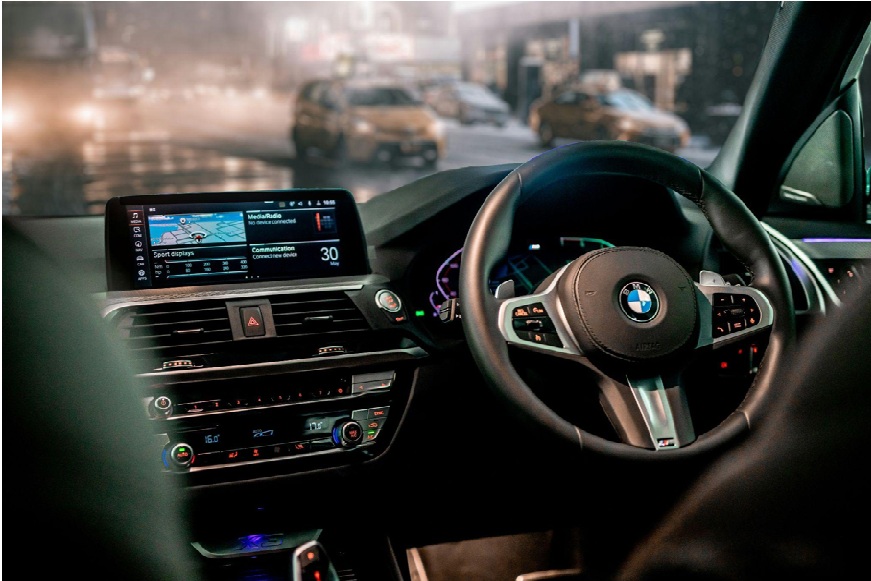
BMW Operating System 7, which powers iDrive 7, debuted in the G05 X5 in 2018 and was subsequently fitted to the G20 3 Series, G01 X3, G07 X7, and virtually every other BMW sold between approximately 2018 and 2021. For anyone buying a used BMW today in the UK, iDrive 7 is the system they are most likely to encounter.
The headline visual change was the introduction of the Live Cockpit Professional configuration: a 10.25-inch touchscreen and a 12.3-inch digital instrument cluster, both mounted in a continuous strip ahead of the driver and front passenger. The arrangement made the cabin feel genuinely modern without the maximalism that would come later.
Underneath the hardware, iDrive 7 introduced Remote Software Upgrade capability, the ability to update the car’s software over the air rather than requiring a dealer visit. It also introduced the BMW Intelligent Personal Assistant, activated by the phrase “Hey BMW”, which could handle navigation inputs, make calls, and adjust climate settings in natural language.
The BMW head unit architecture of this generation also brought parking assistance into the central display more completely than before. BMW parking sensors, both front and rear Park Distance Control (PDC), had been available as options for years, but iDrive 7 brought the visual overlay of parking sensor data, 360-degree surround-view camera feeds, and active parking assist onto the main screen in a cleaner, more integrated way than earlier systems had managed.
iDrive 7 is the system most used BMW buyers will encounter, and for good reason. It is the point where the hardware and software genuinely came together.
iDrive 8: The Biggest Visual Overhaul
BMW Operating System 8, launched in 2021 with the iX and the G26 4 Series Gran Coupé, was the most dramatic visual redesign iDrive had seen. The twin-screen arrangement of iDrive 7 gave way to a single curved glass surface housing a 12.3-inch digital driver display and a 14.9-inch central touchscreen. The result looked like one continuous display rather than two separate screens.
The rotary controller was retained, which proved a quietly significant decision. Rivals including Tesla had moved to all-touchscreen interfaces, and BMW’s own research consistently showed that controller-based input was faster and required less visual attention than touchscreen alternatives.
BMW screens of the iDrive 8 generation also pushed deeper into the car’s systems. Climate controls, which had occupied physical buttons on the centre console in every previous BMW, moved into the touchscreen, a decision that proved divisive. The argument for it was interior minimalism. The argument against it was the same as always: physical controls can be operated without looking.
On the audio side, iDrive 8 introduced tighter integration with Harman Kardon and Bowers & Wilkins speaker systems through the head unit. The BMW speakers on premium variants, particularly the Bowers & Wilkins 1,275-watt system available on the 7 Series and X7, became accessible through dedicated equaliser and speaker configuration menus in the iDrive interface, allowing a level of audio customisation that earlier generations had not offered.
iDrive 8.5, introduced as an over-the-air update in 2023 for compatible iDrive 8 cars, reworked the home screen layout with a Quick Select toolbar, making the most-used functions more immediately accessible without navigating menus.
iDrive 9: The Android Era and the End of the Controller
BMW Operating System 9 arrived in late 2023, initially on the F70 1 Series and the U11 X1 and X2. It represented a structural change as significant as any since the original: the software base moved to Android, and the rotary controller was removed entirely.
iDrive 9 brings a 10.25-inch driver display and a 10.7-inch central touchscreen, modest figures compared to iDrive 8’s curved panel, reflecting the smaller vehicles it debuted in. Three physical shortcut keys sit beside the screen for the most common inputs. Voice control through the BMW Intelligent Personal Assistant is more capable than any previous generation, handling multi-step requests and learning driver preferences over time.
The Android foundation also opens the system to third-party app developers in a way the previous proprietary software did not, and over-the-air updates can now deliver genuine feature additions rather than merely bug fixes and map refreshes.
What This Means If You Own or Are Buying a Used BMW
Understanding iDrive generations is practically useful, not just interesting. The system fitted to a specific vehicle determines the BMW screen layout, the integration of the BMW multimedia functions, the parking sensor display, and whether features such as wireless CarPlay, over-the-air updates, and voice navigation are available. A G20 3 Series from 2019 will have iDrive 7. A G20 facelift from 2022 may have iDrive 8. An F70 1 Series from 2024 will have iDrive 9 with no rotary controller. These are not cosmetic differences. They affect how the car feels every day.
For owners who need to replace a damaged or failed in-car entertainment system, the practical option is nearly always a genuine used BMW head unit from a specialist dismantler. Aftermarket units are available, but genuine BMW components retain full integration with parking sensors, camera systems, climate controls, and the rest of the car’s electronics, something third-party alternatives typically cannot replicate.
For sourcing used BMW iDrive parts in the UK, MT Auto Parts (Thurnscoe, South Yorkshire) is a specialist dismantler covering the F, G, and U generation BMW range, the 1 Series through to the iX3, iX, and i7. They carry iDrive head units, BMW screens, speaker systems, parking sensor modules, and associated wiring dismantled from donor vehicles, with recorded mileage and condition descriptions on every listing. Almost all parts include a 30-day warranty, and free standard delivery is available across UK mainland addresses for items under 20 kg, with most orders dispatched within 24 to 48 hours. The business has accumulated over 17,500 five-star reviews. For specific part availability and compatibility, listings can be checked directly at mtautoparts.com.
The iDrive version fitted to a used BMW isn’t just a spec detail. It shapes everything from daily usability to which features can be retrofitted or repaired.
What Comes Next
Panoramic iDrive, BMW Operating System X, was announced in early 2025 for the Neue Klasse electric models. It takes the large-format screen architecture further still: a dashboard-spanning curved display replaces the conventional instrument cluster entirely, and the head-up display expands into a panoramic projection surface.
The rotary controller will not return. Voice interaction, supplemented by a large language model for more conversational responses, is BMW’s chosen direction. Whether that proves, with hindsight, to have been exactly right, or a decision BMW revisits in the decade that follows, is one of the more interesting open questions in modern automotive design.
For anyone buying a used BMW today, the answer is more immediate: find out which iDrive generation is fitted before you buy, and if anything in that system ever needs replacing, make sure you source a part from a supplier who can tell you exactly what vehicle it came from.
Disclaimer: Technical specifications, feature availability, and model year information are provided for general reference only and may vary by market, trim level, and build date. Always confirm details with the manufacturer or a qualified BMW dealer. Used part availability, condition, and compatibility are subject to individual supplier listings.